
Repository Radar - PR#13
Keeping an eye on the world of OSS software - one scan at a time


Welcome to PR#13 of Repository Radar – your no-fluff scan of open-source software infrastructure. This week, we explore systems that reshape developer experience, data access, and identity orchestration. From Crawl4AI’s intelligent web scraping to Vanna’s natural language SQL and Better Auth’s framework-agnostic auth layer, these projects show how OSS is bridging human intent and software execution. Let’s dive in. 🧠🔧
📡 ABOVE THE RADAR (aka the BFD)
In “above the radar” we take a look at some of the big splash software infrastructure announcements and go on the hunt for OSS that are similar.
Just last week, Thinking Machines Lab - helmed by former OpenAI CTO Mira Murati and backed by a record‑breaking $2 billion seed round - announced plans to build multimodal, context-aware agents that can “interact through conversation, through sight, through the messy way we collaborate” and will include an open-source component on launch.
This underscores a key shift: next-gen AI agents aren’t just conversational - they perceive, remember, and act across modalities without needing constant prompting. As enterprise devs weigh privacy, control, and customizability, open-source alternatives are gaining traction as real agent-infrastructure foundations.
The repos in PR#13 exemplify this shift:
Crawl4AI - reframing web scraping as an LLM-friendly, schema-driven pipeline
Vanna - enabling natural-language SQL queries via RAG-powered translation
Better Auth - providing framework-agnostic identity and auth management
Supervision - offering modular vision tools for perceptual agents
Together, they form a modular agentic stack - covering perception, knowledge, identity, and action - built in the open. If Thinking Machines is shaping the future of multimodal agents at scale, these projects are creating the foundational glue that makes agentic systems possible under developers’ control - and without the lock-in.
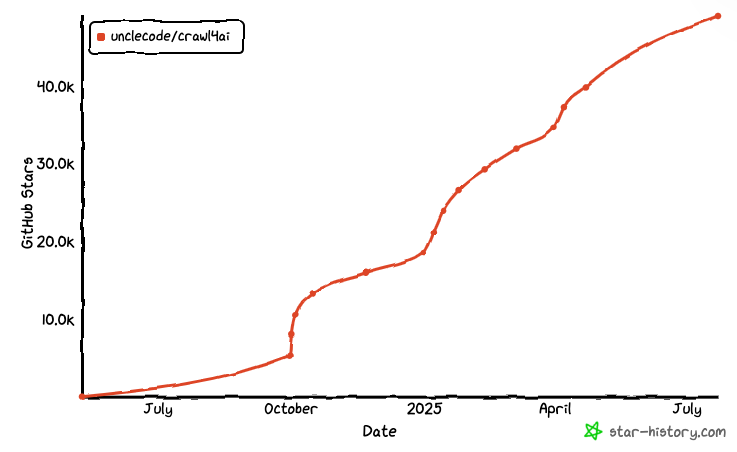
🌐 Crawl4AI (GitHub)48.2k ☆ – Open-Source LLM Friendly Web Crawler & Scraper

The Scoop: Crawl4AI is a blazing-fast, AI-ready web crawler tailored for large language models, AI agents, and data pipelines. It's open-source, flexible, and built for real-time performance - perfect for extracting clean, structured Markdown and JSON for downstream applications.
Why It's a Big Deal:
Adaptive Crawling learns site patterns and stops when enough info is collected
Supports infinite scroll, intelligent link previews, async URL seeding, and high concurrency
Outputs LLM-friendly formats (Markdown, structured JSON), ideal for RAG/fine-tuning workflows
Under the Hood:
Built in Python, with AsyncWebCrawler & Playwright-based browser control
Browser/session hooks, proxy support, stealth mode, and virtual scroll for dynamic pages
Modular extraction strategies: CSS/XPath, LLM-driven schema extraction, metadata, media, PDF parsing
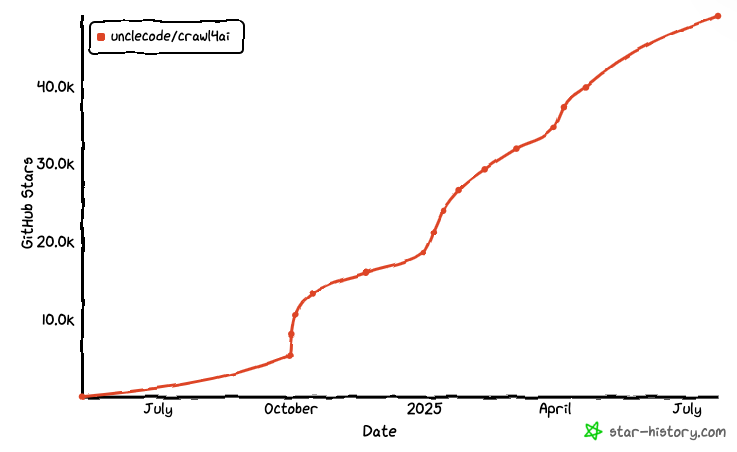
Crawl4AI democratizes AI pipelines by reimagining data harvesting as a smart, structured, and agent-friendly process - empowering developers to gather high-quality knowledge at scale.
🔭 ON THE RADAR
Stuff that’s hot and is trending at over 10K stars.
📷 Supervision (GitHub) 28.6k ☆ – CV Utilities for Object Detection & Segmentation

The Scoop: Supervision by Roboflow is a robust, reusable toolbox for computer vision workflows centered on object detection, segmentation, tracking, annotation, and metrics. It simplifies integrating with models like YOLO, Detectron, and Transformers.
Why It's a Big Deal
Streamlined inference pipeline: loading, detecting, filtering, annotating in just a few lines
Rich utilities: tracking, keypoint detection, bounding‑box conversions, zone filtering, and counting
Under the Hood
Written in Python; integrates seamlessly with Roboflow inference, Ultralytics YOLO, Transformers
Excellent docs and cookbooks on usage patterns
Supervision simplifies computer vision operations with modular, composable utilities that unify common tasks across detection and tracking workflows.
💡 Vanna (GitHub) 19.6k ☆ – Natural-Language Interface for SQL Databases

The Scoop: Vanna is an open-source Retrieval-Augmented Generation (RAG) framework that translates natural language questions into SQL queries, with optional execution against your database.
Why It's a Big Deal
Enables non-technical users to chat with SQL databases via Slackbot, Streamlit, Flask, Chainlit, etc.
Strong ecosystem: adapters for OpenAI, ChromaDB, Pinecone, vector stores; multi-platform clients
Under the Hood
Python-based RAG pipeline: document indexing + LLM prompting → SQL
Modular architecture:
VannaBase, provider-agnostic, deployments via Slack, web, Jupyter
Vanna reimagines database querying as a conversational process, bridging human intent and SQL logic through a modular RAG architecture.
🔐 Better Auth (GitHub) 16.7k ☆ – Framework‑Agnostic Auth & Authorization for TypeScript

The Scoop: Better Auth is a comprehensive authentication & authorization library for TypeScript/JavaScript apps. It's framework-agnostic, configurable, and designed to avoid reinventing auth across apps.
Why It's a Big Deal
One-stop solution: email/password, magic links, OTPs, social (GitHub, Google, Twitter, Slack, etc.), SSO, 2FA, multi‑tenant
Plugin-driven ecosystem covers sessions, rate-limits, password resets, account linking
Enterprise-ready: recently added OIDC/SAML, encryption for tokens, multi-team support;
Under the Hood
Core built in TypeScript; supports Next.js, Express, Svelte, Solid, Remix, and more
Config via JS/TS objects: secrets, DB dialects, session handling, plugins
Better Auth unifies modern authentication under a single, extensible layer, enabling secure, provider-agnostic identity flows across frameworks.
🔬 BELOW THE RADAR
Our hot picks for recent OSS projects to keep a close eye on for the future.
🧩 Checkmate (GitHub) 7.3k ☆ – Infrastructure Uptime & Hardware Monitoring

The Scoop: Checkmate is a powerful, self-hosted monitoring platform designed to track website uptime, server health, hardware stats, and incidents. It offers slick dashboards, real-time alerts, and integrations with popular messaging platforms. With support for over 1,000 monitors and optional hardware agents, it's ideal for developers and sysadmins looking for reliable observability.
Get started: Clone the repo and set up the environment:
git clone https://github.com/bluewave-labs/Checkmate.git
cd Checkmate
pip install -r requirements.txt
🤖 Sim Studio (GitHub) 5.1k ☆ – Visual AI Agent Workflow Builder

The Scoop: Sim Studio is a drag-and-drop canvas tool for creating complex AI agent workflows - no code required. Users can link LLMs, tools, logic blocks, and APIs in a visual editor similar to Figma. It supports major model providers (OpenAI, Anthropic, Groq) and includes built-in integrations for Gmail, Slack, Notion, Sheets, and more.
Get started: Clone the repo and run locally or in the browser:
git clone https://github.com/simstudioai/sim.git
cd sim
npx simstudio
🕹️ legacy-use (GitHub) 70 ☆ – API Layer for Legacy Desktop Apps

The Scoop: legacy-use transforms legacy GUI-based desktop applications into RESTful APIs using RDP/VNC control and LLM-based automation. It operates as a headless agent that mimics user behavior, sending clicks and keypresses while extracting structured data from legacy apps - no app modifications required.
Get started: Clone the repo and launch the service:
git clone https://github.com/legacy-use/legacy-use.git
cd legacy-use
cp .env.template .env
docker compose up
Repository Radar is brought to you by Alexander, a Partner at Picus Capital, and Claudius, an Investor there. In this Substack, we focus on software infrastructure and open-source innovation in AI and beyond, tracking major trends while uncovering the hidden gems shaping the future of technology.