
Repository Radar - PR#14
Keeping an eye on the world of OSS software - one scan at a time


Welcome to PR#14 of Repository Radar – your no-fluff scan of open-source software infrastructure. This week, we spotlight tools redefining infrastructure management, developer workflows, and agent-powered authoring. Anchored by OpenTofu’s bold fork of Terraform, these projects reflect how OSS is pushing control, composability, and collaboration back into developers’ hands. Let’s dive in. 🧠🔧
📡 ABOVE THE RADAR (aka the BFD)
In “above the radar” we take a look at some of the big splash software infrastructure announcements and go on the hunt for OSS that are similar.
Just last week, the OpenTofu project - a community-driven fork and ambitious evolution of Terraform - surged into the spotlight after HashiCorp officially ended support for Terraform’s open-source version in July 2025.
This milestone follows a longer arc: back in August 2023, HashiCorp announced a license switch from the permissive MPL to the Business Source License (BSL), effectively closing Terraform’s future development to the community. That change forced infrastructure teams to choose between adopting Terraform Enterprise, freezing on the last OSS release, or migrating to a fork.
What happened next has few parallels in modern open-source history. OpenTofu, born from that rift and backed by the Linux Foundation, has quickly gained the confidence of major enterprises. Notably, Fidelity Investments reported migrating thousands of applications to OpenTofu - citing a smooth transition, full backward compatibility, and stronger community responsiveness than they’d previously seen with vendor-led support.
This moment represents more than a fork. It’s the first time a core DevOps tool - widely integrated into production stacks - has been effectively sunset by its own vendor, only to be rebooted by the community under a more open, modular, and transparent governance model.
The repos in PR#14 speak to this shift in developer infrastructure priorities:
OpenTofu – safeguarding core infrastructure workflows under an open, community-first license
Coze Studio – open-sourcing enterprise-grade agent design and deployment tooling
Reflex – enabling full-stack web app development in pure Python with serverless deploys
KubeSphere – simplifying Kubernetes operations with a modular, multi-tenant control plane
Together, they reflect a rebalancing in the developer stack: from vendor-driven lock-in to modular, OSS-first building blocks that let engineers shape infra around their needs - not the other way around. OpenTofu’s momentum may be rooted in reaction, but it’s grown into something much bigger: a signal that developer sovereignty in infrastructure tooling is not only viable - it’s winning.
🌐 OpenTofu (GitHub) 17.3k ☆ – Modular Terraform Alternative

The Scoop: OpenTofu is an open-source fork of Terraform under the MPL‑2.0 license, hosted by the Linux Foundation since April 2025. It provides drop-in compatibility with Terraform HCL and workflows while ensuring community governance and vendor neutrality. Perfect for infrastructure as code pipelines that demand transparency, stability, and extensibility.
Why It's a Big Deal:
Full Terraform compatibility: works with existing .tf files, modules, providers, and HCL syntax with no rewrites needed.
Governance backed by the Linux Foundation and over 140 supporting organizations ensures long-term sustainability and open collaboration.
Rapid innovation and stability improvements, with active community-led development and frequent releases (v1.10.3 released 5 days ago).
Under the Hood:
Written in Go, OpenTofu builds a resource graph to parallelize execution and efficiently manage dependencies.
Supports declarative IaC via modules, execution planning, and state management - mirroring Terraform’s UX.
Provides easy installation across platforms: native packages for Debian (.deb), RPM, Homebrew, Snap, OCI container, and standalone binaries.
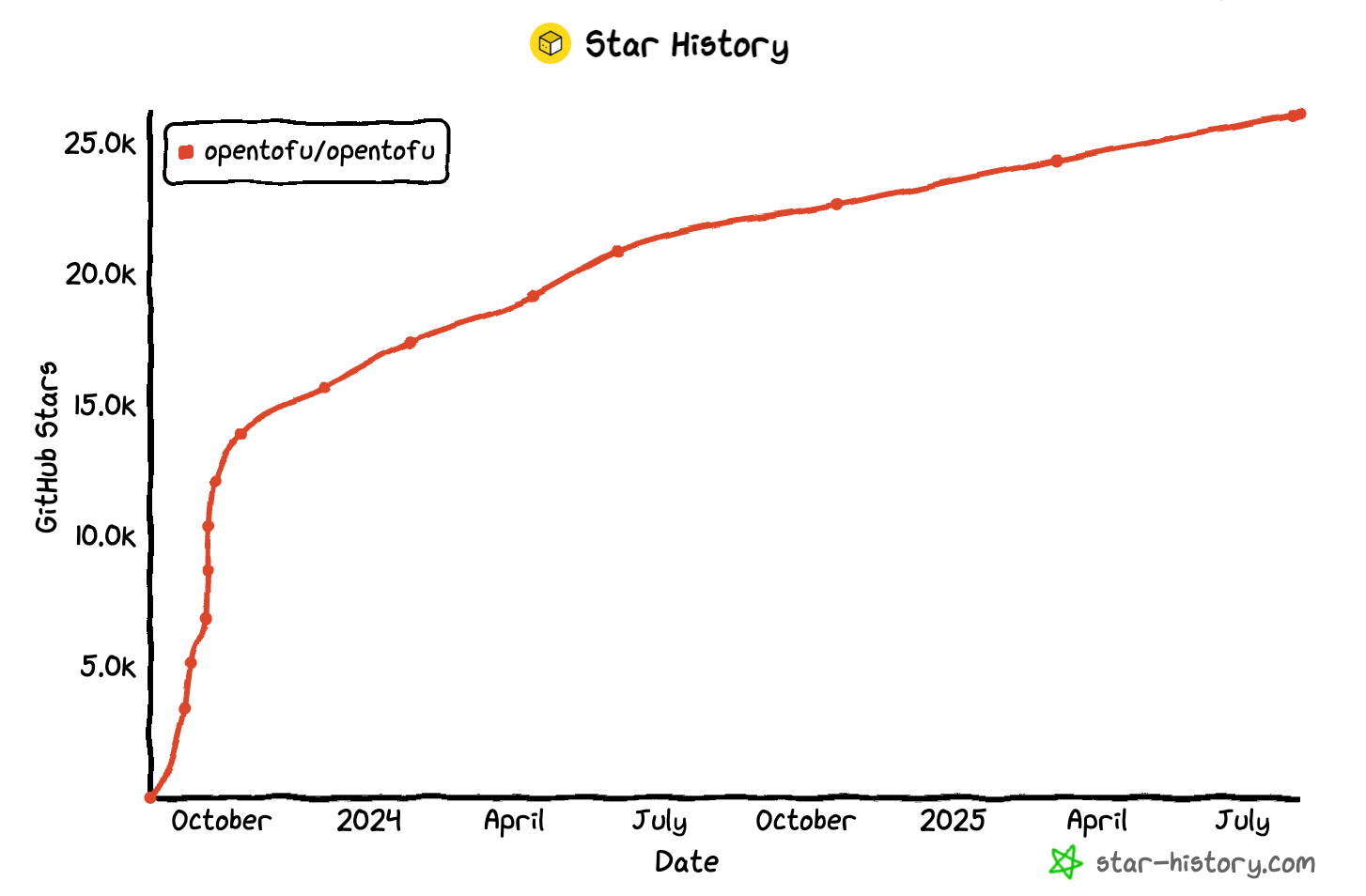
OpenTofu empowers DevOps teams and platform engineers to seamlessly migrate from Terraform, preserve existing workflows, and operate under a neutral, community-first governance model.
🔭 ON THE RADAR
Stuff that’s hot and is trending at over 10K stars.
🎛️ Reflex (GitHub) 24.4k ☆ – Declarative Development Environments

The Scoop: Reflex is a full-stack framework that lets you build frontend and backend entirely in Python - no HTML, CSS, or JavaScript required. It offers high‑level UI components, built-in database integration, AI agents, and CLI deploys to quickly launch production apps. Great for Python-first developers wanting to ship full-featured web applications fast.
Why It's a Big Deal
Full control: define UI and state in Python, including event handlers and routing
Instant deploy: CLI tools for local dev and hosting via Reflex Cloud or custom infra
Growing ecosystem: example apps, prebuilt components, and frequent updates
Under the Hood
Built with FastAPI and Next.js under the hood, abstracted away for dev simplicity
Ships with hot reload, form/state handling, and native support for async code
Python package, installable via pip
Reflex rethinks full-stack development by letting Python developers build polished web apps with zero JavaScript overhead.
☸️ KubeSphere (GitHub) 16.5k ☆ – Enterprise-grade Kubernetes Platform

The Scoop: KubeSphere is an open-source container platform that layers a powerful UI and DevOps toolset on top of Kubernetes. It supports multi-cluster, multi-cloud, and hybrid deployments with built-in observability and role-based access control.
Why It's a Big Deal
All-in-one: DevOps pipelines, GitOps, observability, network policies, and service mesh
Enterprise features: RBAC, tenant isolation, multi-cluster federation
Extensible: plug-in modules via “microkernel” architecture
Under the Hood
Built on Kubernetes, uses CRDs and native K8s APIs
Modules include CI/CD (Jenkins), monitoring (Prometheus), and alerting (Alertmanager)
Web console + CLI for unified cluster control
KubeSphere abstracts the complexity of Kubernetes, making it easier for enterprises to adopt cloud-native architectures at scale.
✍️ Coze Studio (GitHub) 14.4k ☆ – Collaborative Editor Platform

The Scoop: Coze Studio is an open-source, visual IDE to design, manage, and deploy LLM-based AI agents. Originally built by ByteDance, it supports drag-and-drop workflows, plugin integration, RAG pipelines, and agent deployment with minimal code.
Why It's a Big Deal
Frontend in React + Tailwind, backend in Go
Uses WebAssembly for sandboxed plugin execution
Modular microservices architecture under Apache 2.0
Under the Hood
Built in Rust, leveraging performance and security benefits
Staged collaboration model for controlled editing
Rich plug-in architecture and community contributions
Coze Studio is a serious open-source contender for teams building interactive LLM apps without needing to manage backend glue code.
🔬 BELOW THE RADAR
Our hot picks for recent OSS projects to keep a close eye on for the future.
🤖 Serena (GitHub) 7.5k ☆ – Codebase-Native LLM Agent with Semantic Context

The Scoop: Serena gives LLMs full understanding of your codebase by combining semantic retrieval, symbol indexing, and AST-aware editing. It uses LSPs to extract functions, classes, and relationships, enabling precise and efficient code edits. Works with Claude, GPT, and local models, and integrates with Agno, VS Code, and the CLI.
Get started: Install with pip and connect to your repo:
pip install serena
serena init
Once launched, configure your agents, assign tasks, and kick off workflows through the UI or CLI.
🖥️ Crush (GitHub) 7.4k ☆ – Modern Command-Line Shell

The Scoop: Crush is an AI coding agent for your terminal that integrates tightly with your dev environment. It supports multi-step command reasoning, session history, real-time debugging, and introspection, all from the CLI. Designed to work with your preferred LLM (like OpenAI, Claude, etc.), it’s modular and extensible, and part of the beloved Charm ecosystem.
Get started: Install via Go:
go install github.com/charmbracelet/crush@latest
crush 🧑💻 superglue (GitHub) 1.9k ☆ – Integration Layer

The Scoop: superglue uses natural language to integrate and orchestrate APIs so humans can build faster, and agents can reliably execute across apps and data sources.
Get started: Clone the repo and launch the service:
Visit https://app.superglue.cloud to test and get your superglue api key
[Optional] Configure MCP:
"superglue": {
	"command": "npx",
	"args": [
		"mcp-remote",
		"https://mcp.superglue.ai",
		"--header",
		"Authorization:${AUTH_HEADER}"
	],
	"env": {
		"AUTH_HEADER": "Bearer YOUR_SUPERGLUE_API_KEY"
	}
}
Prompt it with something like:
Find the most popular LEGO themes by number of sets on the following DB: postgres://superglue:superglue@database-1.c01e6ms2cdvl.us-east-1.rds.amazonaws.com:5432/lego
Repository Radar is brought to you by Alexander, a Partner at Picus Capital, and Claudius, an Investor there. In this Substack, we focus on software infrastructure and open-source innovation in AI and beyond, tracking major trends while uncovering the hidden gems shaping the future of technology.