
Repository Radar - PR#17
Keeping an eye on the world of OSS software - one scan at a time


Welcome to PR#17 of Repository Radar – your no-fluff scan of open-source software infrastructure. This week features Real-Time-Voice-Cloning, Perplexica, simdjson, and Haystack. From voice mimicking to privacy-first search, blazing JSON performance, and end-to-end LLM pipelines, OSS continues to power the backend of what’s next.
📡 ABOVE THE RADAR (aka the BFD)
In “above the radar” we take a look at some of the big splash software infrastructure announcements and go on the hunt for OSS that are similar.
In California, lawmakers recently passed a landmark bill requiring companies working with “frontier” AI models to disclose and certify safety testing, a move aimed at ensuring transparency for the most powerful systems. At the same time, Senator Ted Cruz introduced a regulatory “sandbox” proposal that would allow AI companies to apply for temporary exemptions from certain federal regulations — but only if they commit to mitigating safety and financial risks.
These regulatory shifts set the stage for the repos in this episode:
Haystack — orchestration pipelines built for production, control, and modularity
Real-Time-Voice-Cloning — high fidelity voice tech built for speed and realism
Perplexica — privacy-first, self-hosted search / RAG workflows for data sovereignty
simdjson — pushing the envelope on parsing speed and infrastructure efficiency
Together, they illuminate what open source must deliver in this moment: systems that are fast, transparent, private, and production-ready.
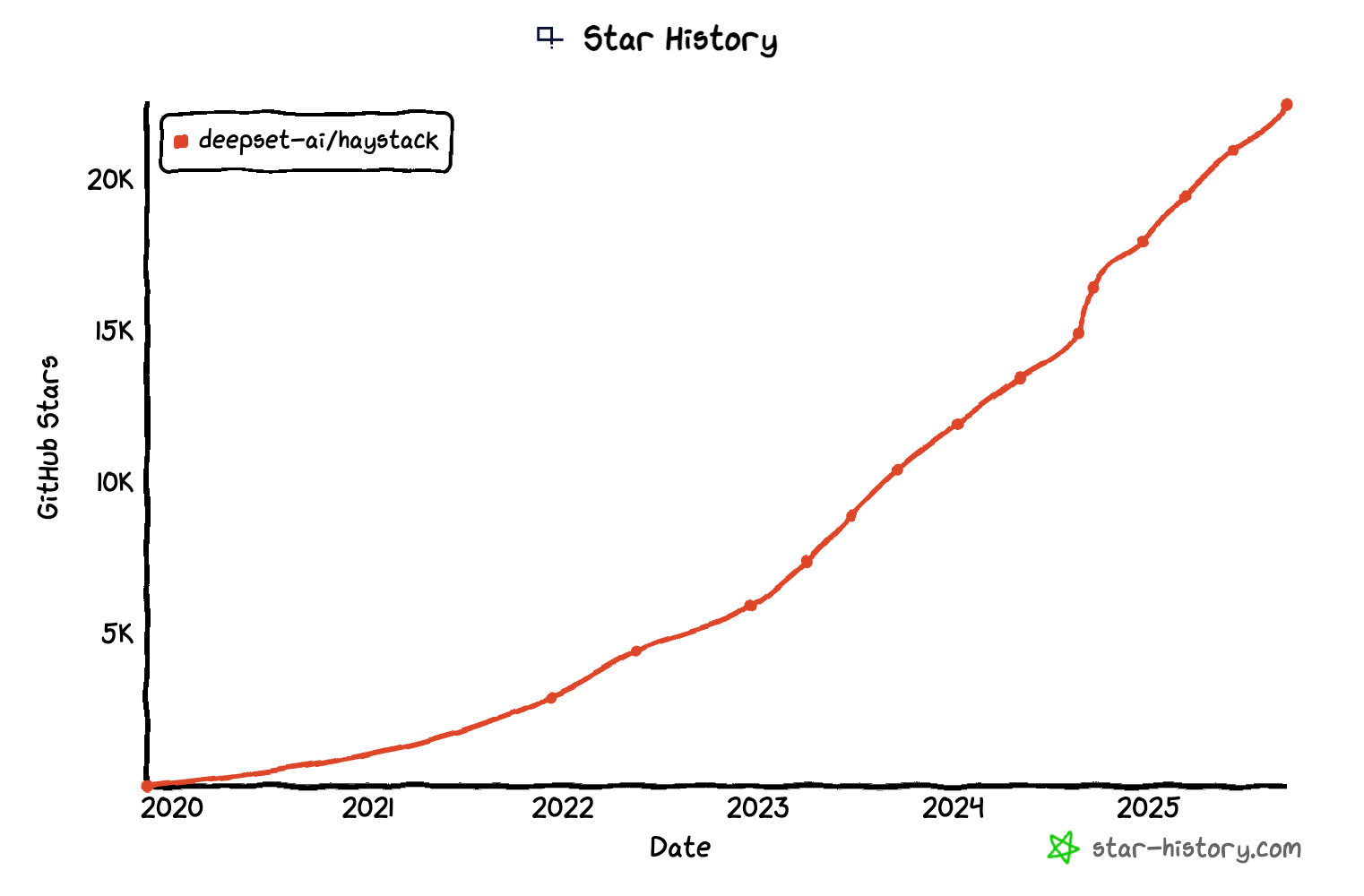
📚 Haystack (GitHub) 22.5k ☆ – AI Orchestration Framework for LLM Applications

The Scoop: Haystack by deepset is an open-source orchestration framework to build customizable, production-ready large language model (LLM) applications. It connects components - models, vector databases, file converters - into pipelines or agents that interact with your data. It excels at retrieval-augmented generation (RAG), semantic search, question answering, and conversational applications.
Why It’s a Big Deal
Enables modular construction of NLP systems so users can pick and choose (or swap out) components: embedding models, retrievers, LLMs.
Supports both scale and flexibility: millions of docs, multiple file types, a variety of vector DBs and LLM sources.
Bridging research & production: has strong dev tooling, production-ready deployment options (REST API endpoints, versioning, etc.), enterprise features.
Under the Hood
Written mainly in Python; integrates with a wide range of embedding models (OpenAI, Hugging Face, etc.), vector databases, and file converters.
Provides transparent, extensible pipelines so users can build custom components or replace existing ones.
Can be installed via pip (or Docker), comes with examples, docs, deployment options (e.g. via REST with “Hayhooks”).
Haystack is powerful for anyone wanting to build serious NLP applications - whether it’s internal knowledge search, chatbots over custom data, or RAG-based content generation - without starting from scratch.
🔭 ON THE RADAR
Stuff that’s hot and is trending at over 10K stars.
🎙️ Real-Time-Voice-Cloning (GitHub) 55.7 ☆ – Instant Voice Cloning

The Scoop: Real-Time-Voice-Cloning is a deep learning system for generating speech that mimics a target speaker’s voice. Given just a few seconds of reference audio, it can synthesize arbitrary speech in that voice with high fidelity and low latency. Built on a three-stage pipeline (speaker encoder, synthesizer, vocoder), it remains one of the most widely used open-source projects for cloning voices.
Why It’s a Big Deal
Democratizes advanced voice synthesis with a fast, minimal setup.
Useful for prototyping conversational agents, accessibility tools, and creative projects.
A go-to reference implementation for many follow-up research and commercial systems.
Under the Hood
Based on SV2TTS: speaker encoder (generalized embeddings), Tacotron2-like synthesizer, and WaveRNN vocoder.
Pretrained models available for immediate inference.
Supports training on your own dataset for custom speaker adaptation.
Real-Time-Voice-Cloning paved the way for today’s rapid progress in speech synthesis and still serves as a foundation for many voice AI experiments.
🧠 Perplexica (GitHub) 24.6k ☆ – Local AI-Powered Search Engine

The Scoop: Perplexica is an open-source, AI-native search engine that runs locally. Instead of sending queries to a cloud provider, it uses retrieval-augmented generation (RAG) to fetch documents, chunk and embed them, and generate answers through a local or API-connected LLM. Designed for privacy and sovereignty, it provides an alternative to cloud search products.
Why It’s a Big Deal
Puts users in control of their data - everything runs locally.
Offers a customizable, developer-friendly framework for embedding search into apps.
Competes with cloud-native AI search by offering transparent, hackable infrastructure.
Under the Hood
RAG pipeline with vector databases, embeddings, and chunking strategies.
Pluggable backends: OpenAI, Ollama, HuggingFace, and more.
Simple web UI plus API for programmatic access.
Perplexica exemplifies the shift toward local-first AI tooling, giving developers the ability to deploy AI search without vendor lock-in.
⚡ simdjson (GitHub) 21.9k ☆ – The World’s Fastest JSON Parser

The Scoop: simdjson is a high-performance JSON parser built in C++ that exploits SIMD (Single Instruction, Multiple Data) instructions to parse gigabytes of JSON per second. It’s designed for extreme speed and correctness, handling real-world messy JSON while outperforming conventional parsers.
Why It’s a Big Deal
Processes JSON at gigabyte scale with minimal latency.
Critical for high-throughput systems, real-time analytics, and low-latency APIs.
Sets the benchmark for modern JSON parsing libraries.
Under the Hood
Uses SIMD acceleration (AVX2, ARM NEON, AVX-512) to parse multiple bytes at once.
Compatible with C++17, with bindings for other languages (Rust, Python, Go, etc.).
Built-in validation ensures JSON compliance while remaining blazing fast.
simdjson shows how low-level optimization and algorithmic engineering can reshape fundamental infrastructure for the data-driven web.
🔬 BELOW THE RADAR
Our hot picks for recent OSS projects to keep a close eye on for the future.
🎨 ART (GitHub) 7.2k ☆ – Automated Reasoning Trainer

The Scoop: ART is a benchmark and training framework for teaching LLMs automated reasoning. It focuses on logical consistency, chain-of-thought generation, and improving reasoning robustness across diverse tasks. The repo provides datasets, evaluation scripts, and model-training utilities designed to measure and enhance reasoning performance in open-source and commercial models.
Get started: Clone the repo and run evaluations with provided configs.
# Clone and install
git clone https://github.com/OpenPipe/ART.git
cd ART
pip install -r requirements.txt

# Run an evaluation
python eval.py --model gpt-4 --dataset logic_bench
💻 DeepCode (GitHub) 6.2 ☆ – Open Agentic Coding (Paper2Code, Text2Web, Text2Backend)

The Scoop: DeepCode is an open-source AI development platform that uses a multi-agent system to transform research papers, text prompts, and specs into production-ready code. It supports three major modes: Paper2Code (automated algorithm implementation from academic papers), Text2Web (front-end generation from natural language), and Text2Backend (server-side development from text). By orchestrating specialized AI agents for parsing, planning, and code synthesis, it reduces research bottlenecks, accelerates prototyping, and ensures end-to-end automation from concept to deployment.
Get started: Install from PyPI or source and launch the web interface.
# Install directly from PyPI
pip install deepcode-hku

# Download config & secrets
curl -O https://raw.githubusercontent.com/HKUDS/DeepCode/main/mcp_agent.config.yaml
curl -O https://raw.githubusercontent.com/HKUDS/DeepCode/main/mcp_agent.secrets.yaml

# Run the web dashboard
deepcode
# Opens at http://localhost:8501
🖥️ local-ai-packaged (GitHub) 3k ☆ – Run LLMs Locally, Hassle-Free

The Scoop: local-ai-packaged provides a pre-configured, Docker-packaged environment for running OpenAI-compatible inference APIs locally. It bundles models, serving infrastructure, and management tools into a portable setup, letting developers deploy GPT-like endpoints on-prem or offline without cloud dependencies. Perfect for local testing, privacy-sensitive workloads, or self-hosted AI services.
Get started: Pull the Docker image and launch the local API.
# Clone or pull Docker image
git clone https://github.com/coleam00/local-ai-packaged.git
cd local-ai-packaged
docker compose up

# Access the API at
http://localhost:8080/v1/completions
Repository Radar is brought to you by Alexander, a Partner at Picus Capital, and Claudius, an Investor there. In this Substack, we focus on software infrastructure and open-source innovation in AI and beyond, tracking major trends while uncovering the hidden gems shaping the future of technology.