
Repository Radar - PR#2
Keeping an eye on the world of OSS software - one scan at a time


In our PR#2 of Respository Radar, your go-to pulse check on the biggest moves in software infrastructure and open-source innovation, we're exploring the rapidly evolving AI automation space. A wave of open-source projects is pushing the boundaries of what AI agents can do - from web navigation to workflow automation and enhanced developer productivity. Let’s take a closer look at these projects and their impact.
📡 ABOVE THE RADAR (aka the BFD)
In “above the radar” we take a look at some of the big splash software infrastructure announcements and go on the hunt for OSS that are similar.
The AI automation space is rapidly evolving, with OpenAI introducing Operator, an enterprise-focused automation agent, while Browser-use emerges as an open-source alternative, enabling AI agents to interact directly with web browsers. Operator is positioned as a robust, commercial solution for enterprise automation, while Browser-use takes an open and flexible approach, providing developers with accessible browser-based AI automation. We take a deeper look at this project below, given the hype around Operator.
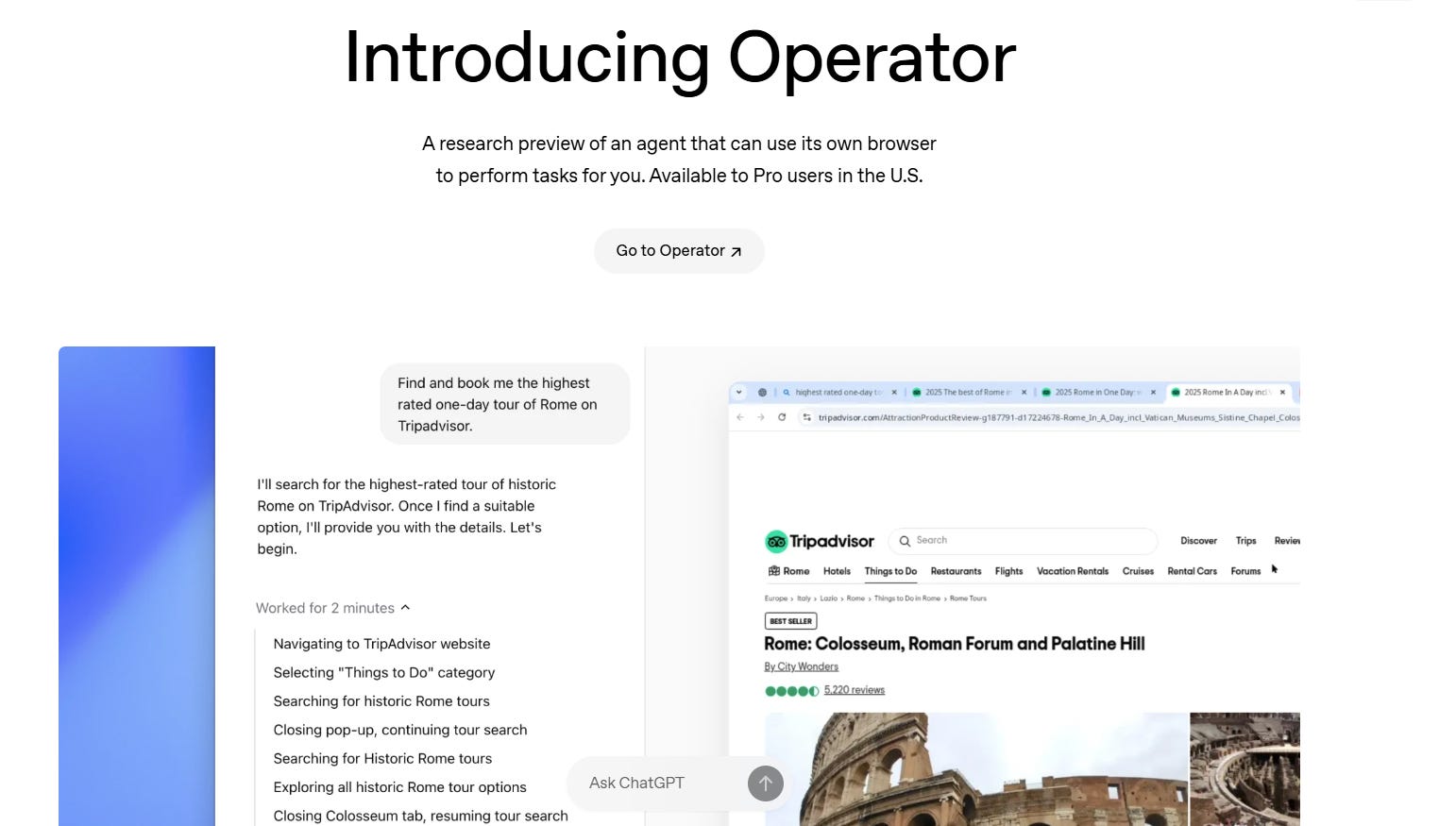
💻 BrowserUse (Github) 29.1k ☆ - Make websites accessible for AI agents

The Scoop: Browser-use is an open-source Python library that enables AI agents to interact with web pages, automating tasks like searching, form-filling, and navigation without requiring a predefined API. This allows for versatile, AI-driven browser automation with minimal setup.
Why It's a Big Deal
Provides an open-source alternative to proprietary AI automation solutions, such as OpenAI’s Operator.
Enables AI agents to interact dynamically with web pages, mimicking human browsing behavior.
Supports various AI models, allowing flexibility in choosing LLMs for different tasks.
Reduces the need for custom web scraping solutions by providing a plug-and-play browser control mechanism.
Offers a hosted version for easy deployment, along with self-hosting options for full control.
Under the Hood
Uses Playwright for web automation, enabling robust interactions with websites.
Works with popular AI models like GPT-4o via LangChain integration.
Provides an intuitive API for developers to quickly define AI-driven web tasks.
Includes support for UI-based testing and automation with frameworks like Gradio.
Designed with extensibility, allowing developers to customize workflows and integrate additional AI capabilities.
Browser-use empowers developers with AI-driven browser automation, allowing for flexible, scalable, and open alternatives to proprietary AI automation solutions. Whether for research, automation, or personal productivity, Browser-use makes it easy to integrate AI into everyday web interactions. We expect more activity around this project in the coming weeks / months.
🔭 ON THE RADAR
Stuff that’s hot and is trending at over 1K stars.
🤖 Devin CursorRules (Github) 4.4k ☆ - AI Agent Capabilities for Cursor and Windsurf IDE

The Scoop: A powerful configuration that transforms the 20 USD Cursor/Windsurf IDE into a Devin-like AI assistant, integrating planning, tool usage, and multi-agent execution.
Why It's a Big Deal
Brings Devin-style agentic capabilities to existing developer IDEs.
Allows AI to plan, execute, and evolve autonomously in software development workflows.
Supports extended tool usage, including web browsing, search engines, and LLM-driven text/image analysis.
Introduces a multi-agent approach, with a Planner powered by o1 and execution by Claude/GPT-4o.
Self-evolves through user feedback, storing learned corrections in .cursorrules for project-specific improvements.
Under the Hood
Uses Playwright for web automation and DuckDuckGo for search integration.
Automates workflows in Cursor, Windsurf, and GitHub Copilot via configuration files.
Supports Cookiecutter for fast setup and templating of AI-augmented environments.
Features step-by-step execution and iterative learning to enhance agent accuracy over time.
🧠 Oumi (Github) 7.2k ☆ - The End-to-End Platform for Training AI Foundation Models

The Scoop: A fully open-source platform for training, evaluating, and deploying AI foundation models at any scale, from 10M to 405B parameters.
Why It's a Big Deal
Enables training and fine-tuning of large-scale AI models with support for techniques like LoRA, QLoRA, and DPO.
Works across multiple model architectures, including Llama, DeepSeek, Qwen, and Phi.
Integrates seamlessly with cloud providers (AWS, Azure, GCP, Lambda) for remote job execution.
Provides a unified API for training, inference, and evaluation, reducing boilerplate.
Optimized for production deployments with inference engines like vLLM and SGLang.
Under the Hood
Supports zero-boilerplate configuration for fine-tuning, distillation, and benchmarking.
Includes native tools for LLM-as-a-judge, data synthesis, and structured evaluation.
Runs efficiently on GPUs and NPUs, leveraging distributed training techniques.
Designed for both research and enterprise AI model development.
⚡ Unsloth (Github) 30.0k ☆ - Faster, Memory-Efficient Fine-Tuning for LLMs

The Scoop: A high-performance framework that enables 2x faster fine-tuning of Llama 3.3, Phi-4, Qwen 2.5, and Mistral models while using 80% less memory.
Why It's a Big Deal
Reduces GPU memory usage, making large-scale model tuning accessible on consumer hardware.
Supports 4-bit and 16-bit QLoRA fine-tuning, optimizing efficiency without compromising accuracy.
Allows for exporting models to GGUF, Ollama, and Hugging Face with seamless integration.
Introduces dynamic quantization and extended sequence lengths for improved LLM performance.
Works with Apple’s ML Cross Entropy for extended-context models, surpassing native limits.
Under the Hood
Written in OpenAI's Triton, ensuring optimized backpropagation and fast training loops.
Implements advanced tensor techniques for memory efficiency in fine-tuning tasks.
Benchmarked against Hugging Face’s standard implementations, showing significant speed and context-length improvements.
Includes preconfigured notebooks for fast experimentation in cloud or local environments.
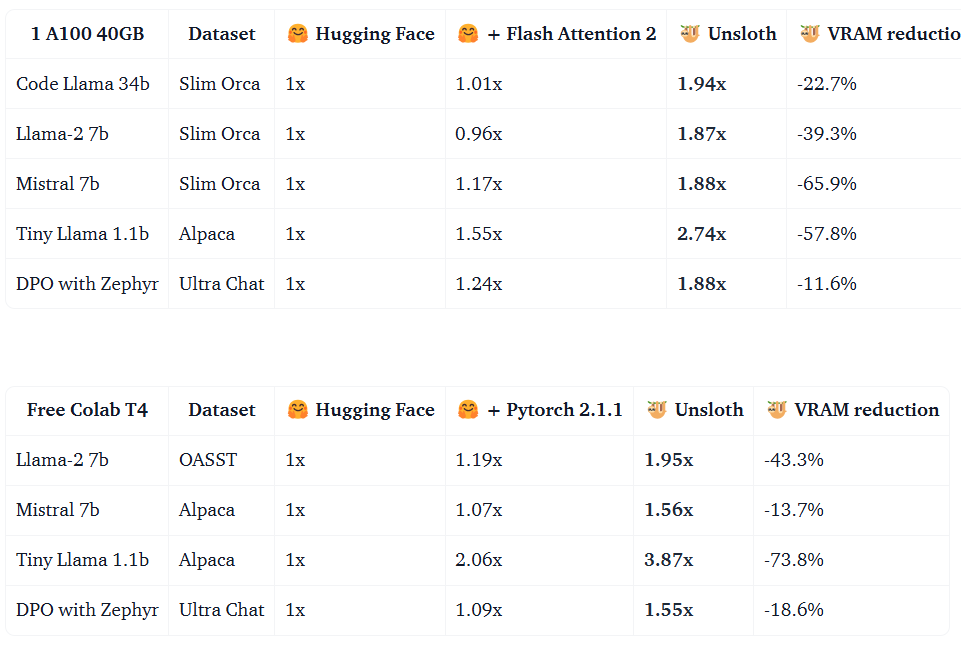
Source: huggingface.co
🔬 BELOW THE RADAR
Our hot picks for recent OSS projects to keep a close eye on for the future.
📈 DeepScaler (Github) 1.5k ☆ - Democratizing Reinforcement Learning for LLMs

The Scoop: DeepScaler is a lightweight scaling solution that optimizes AI model training by dynamically adjusting resource allocation based on workload demands. It enhances training efficiency for large-scale AI models, making it a valuable tool for researchers and engineers working with high-performance computing environments.
Get started with: Install DeepScaler and configure it using a YAML file to optimize your AI training pipeline.
🎥 Goku (Github) 2.1k ☆ - Flow Based Video Generative Foundation Models

The Scoop: Goku is a next-generation image-and-video generative model leveraging rectified flow transformers to deliver industry-leading performance. By integrating advanced flow formulations and meticulously curated datasets, Goku achieves state-of-the-art results in text-to-video, image-to-video, and text-to-image generation.
Get started with: Clone the repository and install dependencies to begin experimenting with Goku's generative models.
📚 Open Deep Research (Github) 4.1k ☆ - A Collaborative AI Research Framework

The Scoop: Open Deep Research is an open-source initiative designed to democratize AI research by providing a modular, scalable framework for training, evaluating, and fine-tuning deep learning models. It supports distributed training across multiple GPUs and cloud instances, enabling researchers to prototype and experiment efficiently.
Get started with: Download the latest release or clone the repository for local development and begin setting up your AI research workflows.
Repository Radar is brought to you by Alexander, a Partner at Picus Capital, and Claudius, an Investor there. In this Substack, we focus on software infrastructure and open-source innovation in AI and beyond, tracking major trends while uncovering the hidden gems shaping the future of technology.
Great that you brought up the operator framework. There's a lot of interesting work being done on the provisioning side for VMs that agents can use to interact with Browsers (and lets see how long until local programs too). Scrappybara is a pretty interesting company in that domain.