
Repository Radar - PR#22
Keeping an eye on the world of OSS software - one scan at a time


Welcome to PR #22 of Repository Radar – your no-fluff scan of open-source software infrastructure. This issue looks at the tug of war between vertically integrated AI clouds and open, portable tooling. CoreWeave is pulling notebooks and model workflows into its platform, while projects like Jupytext, OpenCode, llama.cpp, TOON, Memori, cc-switch, and pg_lake push for formats, runtimes, and infra you can actually own.
📡 ABOVE THE RADAR (aka the BFD)
In “above the radar” we take a look at some of the big splash software infrastructure announcements and go on the hunt for OSS that are similar.
Earlier this quarter, CoreWeave announced a deal to acquire Marimo, the company behind the popular OSS project marimo notebook. Marimo is an AI focused, reactive environment for Python that aims to be reproducible and Git friendly, and CoreWeave plans to fold it into a broader stack that already includes Weights and Biases and OpenPipe.
This move pushes Marimo deeper into a vertically integrated, cloud centric workflow where notebooks, experiments, and compute sit inside one commercial platform. It also raises questions about how independent the project can remain once it becomes part of a larger vendor play. Day to day formats, extensions, and workflows could shift toward CoreWeave specific paths.
That puts more attention on tools like Jupytext, which already offers a cloud independent way to handle notebooks as plain text or scripts and now includes a marimo aware format. With Marimo moving into a bigger platform, it may be a good moment to explore open source alternatives that stay fully decoupled from any one provider.
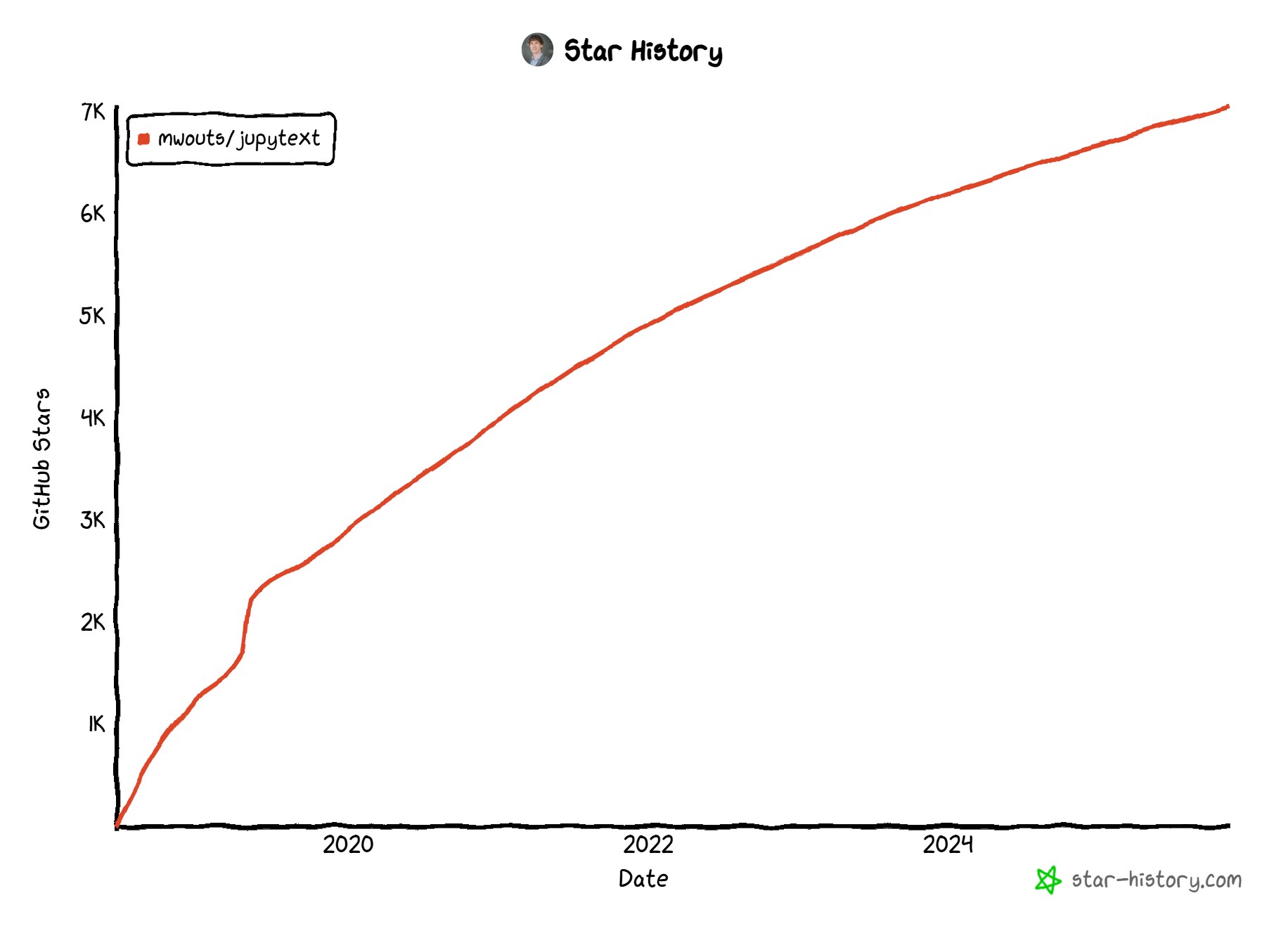
📚 Jupytext (GitHub) 7.0k ☆ - Jupyter notebooks as text and scripts

The Scoop: Jupytext syncs Jupyter ipynb files with script or Markdown formats using clear cell markers. You can version control, search, lint, and edit notebooks in any IDE while still opening them in JupyterLab. Supported formats include py:percent, MyST, Quarto, and py:marimo.
Why It’s a Big Deal
Text formats give readable diffs and clean version control instead of bulky JSON files.
You can apply normal tooling to notebook logic, reducing the gap between exploratory and production code.
Paired notebooks keep ipynb outputs for users who want a UI while the text file stays the source of truth.
Under the Hood
MIT licensed, built in Python, and integrated with JupyterLab so text files can open as notebooks directly.
Multiple formats support different workflows, from code heavy to documentation heavy.
Configurable via CLI or jupytext.toml, making it usable for single files or automated repo wide sync.
Jupytext keeps notebook workflows open and durable across IDEs, repos, and clouds, which matters as more AI notebooks get absorbed into cloud native development stacks.
🔭 ON THE RADAR
Stuff that’s hot and is trending at over 10K stars.
🦙 llama.cpp (GitHub) 90.1k ☆ - Local LLM inference
The Scoop: llama.cpp is the canonical CPU and GPU optimized inference runtime for running LLaMA models locally. It enables efficient quantized execution on laptops, servers, and edge devices without heavyweight dependencies.
Why It’s a Big Deal
Lets developers run large models locally without cloud dependencies.
Highly optimized quantization and kernels bring strong performance to consumer hardware.
Broad ecosystem support makes it a backbone for local AI apps and agent tooling.
Under the Hood
C and C++ codebase with custom kernels and GGUF model format.
CPU first design with GPU support via Vulkan, CUDA, Metal, and OpenCL.
Large contributor community maintains a rapid update cycle.
llama.cpp remains the reference implementation for local model execution and underpins much of the current wave of client side AI tooling.
💬 OpenCode (GitHub) 33k ☆ - Open source coding model and dev assistant

The Scoop: OpenCode provides an open source coding model and assistant with self hosted inference, editor integrations, and structured reasoning improvements. It aims to provide an alternative to commercial coding assistants while remaining hackable and transparent.
Why It’s a Big Deal
Offers a self hosted coding assistant without vendor lock in.
Integrates with mainstream editors and workflows out of the box.
Brings explainability and transparency to model updates and reasoning.
Under the Hood
Built around an open model and lightweight serving stack.
Supports local GPUs and containerized deployments.
Designed for easy extension and embedding into custom developer tools.
OpenCode gives teams control over their coding automation layer while keeping the system inspectable and customizable.
🧾 TOON (GitHub) 18k ☆ - Token efficient JSON alternative for LLM inputs

The Scoop: TOON is a compact, human readable representation of JSON designed for LLM consumption. It blends YAML style indentation with CSV style tables to reduce token usage while preserving deterministic structure.
Why It’s a Big Deal
Reduces token cost for structured data, improving efficiency in LLM heavy apps.
Keeps schemas explicit through length markers and field headers for more reliable parsing.
Fits naturally into prompt construction and data retrieval scenarios.
Under the Hood
MIT licensed format with TypeScript reference implementation.
Lossless round trip encoding to and from JSON.
Supports tabular and nested structures with minimal syntax.
TOON offers a practical way to compress structured context while maintaining clarity, making it useful for agent frameworks, retrieval pipelines, and large context workflows.
🔬 BELOW THE RADAR
Our hot picks for recent OSS projects to keep a close eye on for the future.
🧩 cc switch (GitHub) 4.7k ☆ - Multi provider config manager
The Scoop: cc switch is a cross platform Tauri and Rust desktop app that manages API keys, presets, and MCP servers for Claude Code, Codex, and Gemini CLI. It centralizes configuration and lets you switch providers instantly.
Get started: For Windows - Download the latest CC-Switch-v{version}-Windows.msi installer or CC-Switch-v{version}-Windows-Portable.zip portable version from the Releases page. For Mac: CC-Switch-v{version}-macOS.zip (also via release page).
🧠 Memori (GitHub) 5.3k ☆ - SQL native memory for LLMs and agents

The Scoop: Memori is a SQL backed memory engine that intercepts LLM calls, retrieves context before requests, and stores new interactions after. It works with standard databases and integrates with OpenAI, Anthropic, and LiteLLM.
Get started:
pip install memorisdk🗂️ pg lake (GitHub) 1.2k ☆ - Postgres as a lakehouse engine

The Scoop: pg lake turns Postgres into a lakehouse capable of working with Iceberg tables and object storage files. It uses a modular extension set and a companion DuckDB backed server process to push down heavy query execution.
Get started: Once you’ve built and installed the required components, you can initialize pg_lake inside Postgres.
Repository Radar is brought to you by Alexander, a Partner at Picus Capital, and Claudius, the co-founder of Index Labs. In this Substack, we focus on software infrastructure and open-source innovation in AI and beyond, tracking major trends while uncovering the hidden gems shaping the future of technology.