
Repository Radar - PR#23
Keeping an eye on the world of OSS software - one scan at a time


Welcome to PR #23 of Repository Radar – your no-fluff scan of open-source software infrastructure. This issue lands in the wake of React2Shell, a CVSS 10.0 RCE that exposed how much AI-generated code ships on vulnerable cloud frameworks by default. While hosted app builders scrambled to patch, projects like Dyad, PAL MCP, wshobson/agents, and claude-mem offer a different bet: local execution, multi-model orchestration, and persistent context you control. We also look at RustFS challenging MinIO’s grip on object storage, CodeLayer rethinking how coding agents tackle complex codebases, and next-ai-draw-io turning natural language into architecture diagrams. The thread connecting them is ownership—of your runtime, your models, and your memory.
📡 ABOVE THE RADAR (aka the BFD)
In “above the radar” we take a look at some of the big splash software infrastructure announcements and go on the hunt for OSS that are similar.
Last week, security researchers disclosed React2Shell (CVE-2025-55182), a CVSS 10.0 remote code execution vulnerability affecting React Server Components and Next.js 15.x/16.x. Within hours of the public PoC, Amazon threat intelligence observed exploitation by state-sponsored groups including Earth Lamia and Jackpot Panda. Wiz estimates 39% of cloud environments contain vulnerable instances, and the exploit works with near-100% reliability against default configurations—including blank apps created with create-next-app.
This matters for the AI app builder space because Next.js is everywhere. Tools like v0, Bolt, and Lovable generate Next.js code by default. Vercel hosts a massive chunk of these deployments and scrambled to push WAF rules before the coordinated disclosure went live. If you spun up an AI-generated app in the past few months and haven’t patched, you’re likely exposed.
The incident puts a spotlight on local-first alternatives like Dyad, which runs entirely on your machine and lets you control when patches get applied rather than depending on a hosted platform’s rollout timeline. It also highlights why tools like PAL MCP and the wshobson/agents plugin marketplace matter—they let you orchestrate AI workflows without routing everything through cloud services that inherit framework-level vulnerabilities.
With state actors weaponizing N-day exploits within hours and AI tools churning out framework-dependent code at scale, the security surface of “vibe coding” deserves more scrutiny. This week’s repos offer some paths toward keeping control closer to home.
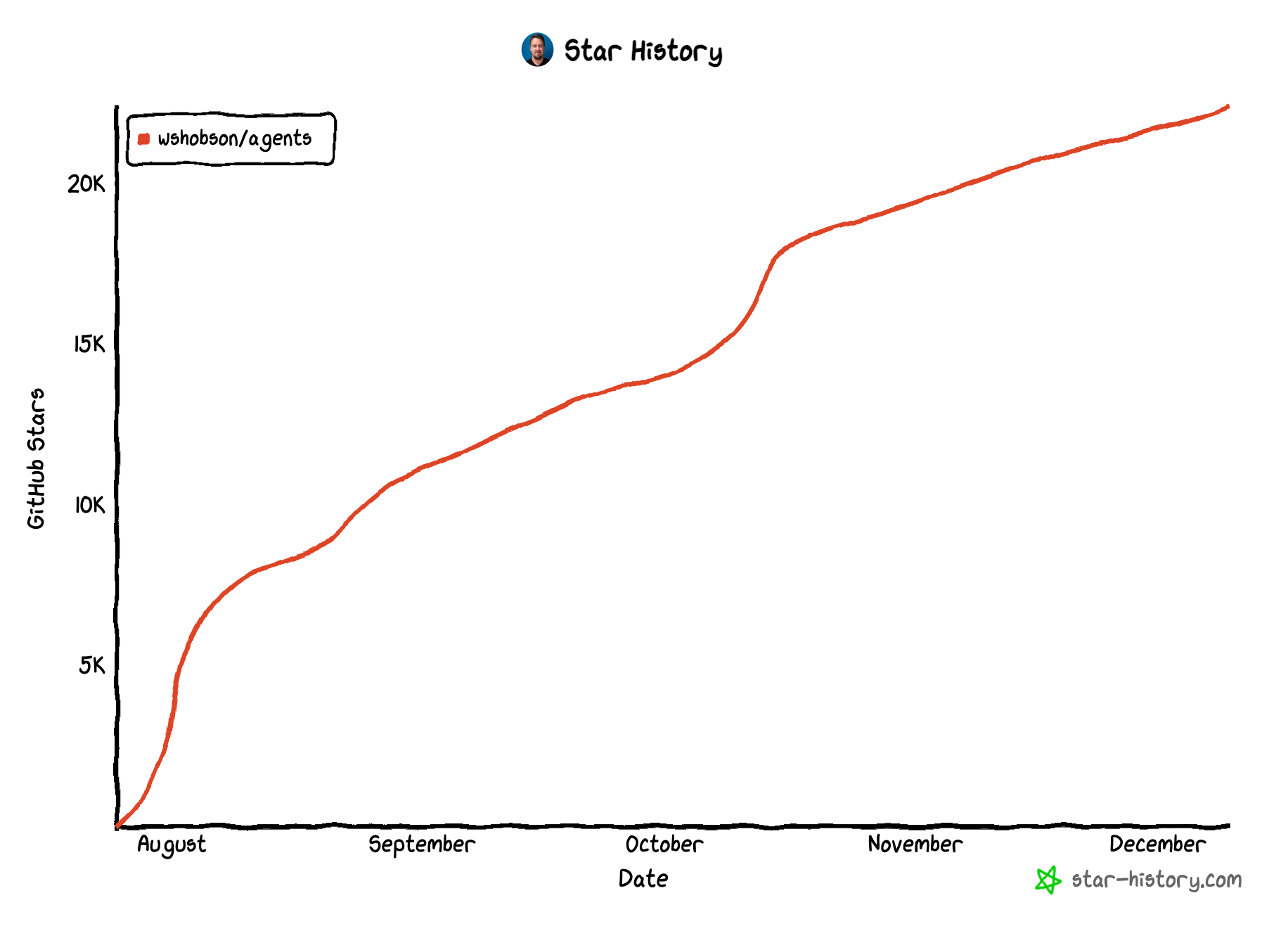
📦 wshobson/agents (GitHub) 22.4k ☆ - Intelligent automation and multi-agent orchestration for Claude Code
The Scoop: A plugin marketplace for Claude Code with 85 specialized AI agents, 47 skills, and 44 development tools across 63 focused plugins. Install only what you need—each plugin loads its own agents, commands, and skills independently, keeping token usage minimal and context clean.
Why It’s a Big Deal
Granular architecture means you compose workflows without loading unnecessary context into your session.
Multi-agent orchestrators handle full-stack development, security hardening, and ML pipelines in coordinated passes.
Hybrid model assignments (Haiku for speed, Sonnet for reasoning) let you optimize cost vs capability per task.
Under the Hood
MIT licensed, Python-based, with a simple
/plugin installcommand to add capabilities.Skills use progressive disclosure—metadata loads first, detailed instructions only when activated.
Covers 23 categories from Python and TypeScript to Kubernetes, blockchain, and SEO workflows.
As agentic coding moves toward modular toolkits rather than monolithic assistants, this repo shows how to scale AI-assisted dev without drowning in context bloat.
🔭 ON THE RADAR
Stuff that’s hot and is trending at over 10K stars.
🛠️ Dyad (GitHub) 18k ☆ - Free, local, open-source AI app builder
The Scoop: Dyad is a desktop AI app builder that runs entirely on your machine—think v0, Lovable, or Bolt but local-first. Bring your own API keys from OpenAI, Anthropic, Gemini, or Ollama, and generate apps without sending code to external services.
Why It’s a Big Deal
Full privacy and no vendor lock-in since everything runs locally and you own your keys.
Cross-platform support for Mac and Windows with no sign-up required.
Open-source under Apache 2.0 (core) with a Functional Source License for pro features, so it stays forkable.
Under the Hood
Built with TypeScript, Electron, React, and Vite for a native desktop experience.
Supports multiple LLM providers including DeepSeek, Qwen, and local Ollama models.
Active release cadence (60+ releases) with growing community on Reddit.
Dyad fills a gap for developers who want AI-assisted prototyping without cloud dependencies or subscription-based builders.
🚀 RustFS (GitHub) 16.2k ☆ - High-performance S3-compatible object storage in Rust
The Scoop: RustFS claims 2.3× faster throughput than MinIO for 4K small files while staying fully S3-compatible. It supports migration and coexistence with MinIO, Ceph, and other S3 platforms, positioning itself as a drop-in alternative with memory safety guarantees.
Why It’s a Big Deal
Rust’s memory model eliminates GC pauses and common leak patterns that plague Go or C-based stores.
Apache 2.0 license avoids the AGPL constraints that complicate MinIO deployments in commercial stacks.
Helm charts and Docker Compose files make Kubernetes deployment straightforward.
Under the Hood
Distributed architecture with erasure coding for fault tolerance across nodes.
Console UI included for bucket management, unlike some minimalist object stores.
One-click install script or Docker quick-start—production use still flagged as early.
For teams evaluating object storage, RustFS offers a performance-focused alternative that sidesteps licensing headaches while betting on Rust’s safety story.
🔗 PAL MCP Server (GitHub) 9.9k ☆ - Multi-model orchestration layer for Claude Code, Codex CLI, and Gemini CLI
The Scoop: PAL (Provider Abstraction Layer) connects your favorite AI CLI to multiple models—Gemini, OpenAI, Grok, Azure, Ollama—within a single conversation. The new clink tool even bridges CLIs together, letting Claude Code spawn Codex subagents or vice versa with full context handoff.
Why It’s a Big Deal
Conversation continuity across models means context flows from one AI to another without manual re-prompting.
Model-specific strengths become composable: use Gemini’s 1M token window for large codebases, O3 for reasoning, Ollama for privacy.
Guided workflows enforce systematic code reviews, debugging phases, and pre-commit validations before you ship.
Under the Hood
Apache 2.0 licensed, Python-based, installs via uv or git clone with auto-config for multiple CLIs.
Supports extended thinking modes and automatically bypasses MCP’s 25K token limit for large prompts.
Provider activation is credential-based—just add API keys in
.envand the provider lights up.
PAL turns your CLI into an orchestrator that drafts in specialists on demand, which matters as multi-model workflows become the norm for serious AI-assisted engineering.
🔬 BELOW THE RADAR
Our hot picks for recent OSS projects to keep a close eye on for the future.
🧠 HumanLayer / CodeLayer (GitHub) 7.6k ☆ - AI coding agent orchestration IDE
The Scoop: CodeLayer is an open-source IDE built on Claude Code that provides battle-tested workflows for complex codebases. From the team that coined “context engineering,” it includes keyboard-first design, MULTICLAU parallel sessions, and worktree support for running multiple Claude instances at once.
Get started: Join the waitlist at humanlayer.dev/code. The SDK and CodeLayer source are Apache 2.0 licensed—clone the repo and follow CONTRIBUTING.md to run locally or contribute.
🎨 next-ai-draw-io (GitHub) 5.8k ☆ - AI-powered draw.io diagram generator
The Scoop: A Next.js app that generates draw.io diagrams from natural language. Supports AWS, GCP, and Azure architecture icons natively, creates animated connectors, and lets you upload existing diagrams for the AI to replicate or enhance. Multi-provider support includes OpenAI, Anthropic, Gemini, Ollama, and more.
Get started: Try the live demo or run locally with Docker: docker run -d -p 3000:3000 -e AI_PROVIDER=openai -e AI_MODEL=gpt-4o -e OPENAI_API_KEY=your_key ghcr.io/dayuanjiang/next-ai-draw-io:latest. Open http://localhost:3000 and start prompting.
💾 claude-mem (GitHub) 1.4k ☆ - Persistent memory plugin for Claude Code
The Scoop: claude-mem captures everything Claude does during coding sessions, compresses it with AI, and injects relevant context back into future sessions. Uses progressive disclosure (index → details → full recall) to save tokens while maintaining continuity. Includes a web viewer UI at localhost:37777 and skill-based search with ~2,250 token savings per session.
Get started: In Claude Code run /plugin marketplace add thedotmack/claude-mem then /plugin install claude-mem and restart. Context from previous sessions automatically appears in new ones—no configuration needed.
Repository Radar is brought to you by Alexander, a Partner at Picus Capital, and Claudius, the co-founder of Index Labs. In this Substack, we focus on software infrastructure and open-source innovation in AI and beyond, tracking major trends while uncovering the hidden gems shaping the future of technology.