
Repository Radar - PR#32
Keeping an eye on the world of OSS software - one scan at a time


Welcome to PR #32 of Repository Radar - your no-fluff scan of open-source software infrastructure. In this issue, we take a closer look at a shift that is becoming harder to ignore: software is no longer static, written once and interacted with occasionally by humans. Instead, it is increasingly something that is continuously interpreted, executed, and evaluated by AI systems across its entire lifecycle. From file classification to agent execution to security scanning, AI is not just generating code - it is actively operating on software systems in real time.
📡 ABOVE THE RADAR (aka the BFD)
In “above the radar” we take a look at some of the big splash software infrastructure announcements and go on the hunt for OSS that are similar.
In this issue, we are starting from a broader system shift rather than a single launch. AI is no longer just helping developers write code. It is increasingly interacting directly with software systems themselves - classifying inputs, executing workflows, and probing for weaknesses in continuous loops.
That matters because it changes where the bottlenecks sit. Many processes that used to be periodic and human-driven are becoming always-on. Systems can now be inspected, tested, and iterated on far more frequently than traditional workflows allowed.
Security is where this becomes most visible. AI systems are now capable of discovering vulnerabilities at a pace that exceeds traditional remediation cycles. The limiting factor is no longer finding issues, but fixing them fast enough. As a result, security shifts from periodic audits to continuous system inspection.
That is the lens for this issue: software is now continuously processed by AI systems across the entire lifecycle - and security is becoming just another automated loop.
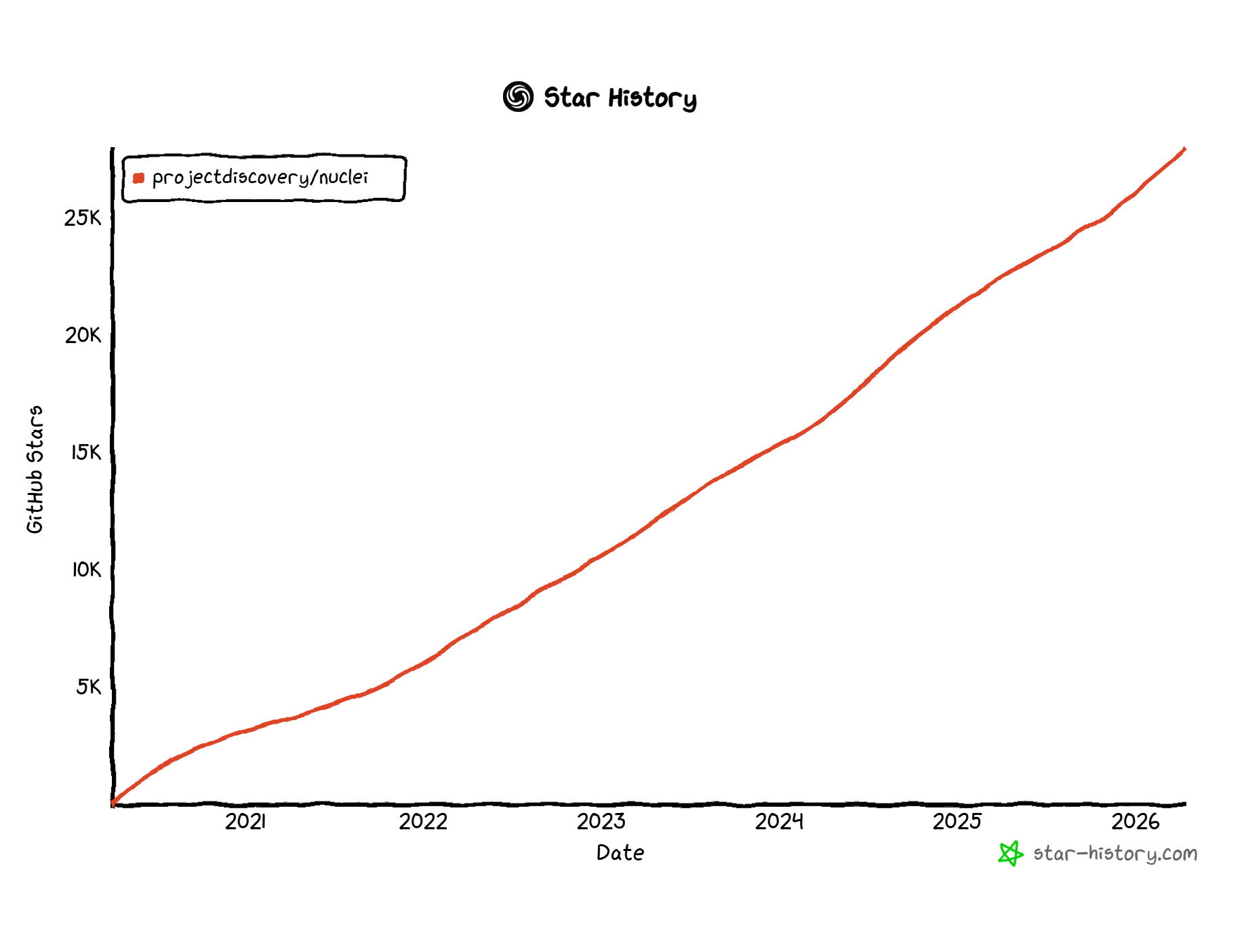
🧰 Nuclei (GitHub) 27.9k ☆ - Programmable vulnerability scanning for continuous security workflows

The Scoop: Nuclei is a high-performance open-source vulnerability scanner built around a simple YAML-based templating system. Instead of relying on fixed scanning logic, it allows users to define custom detection workflows that simulate real-world attack scenarios across applications, APIs, and infrastructure.
Why It’s a Big Deal
It turns vulnerability scanning into a programmable system, where detection logic can be defined, versioned, and shared across teams.
The open template ecosystem allows vulnerability discovery to scale through community contributions and increasingly AI-generated logic.
By integrating into CI/CD pipelines, it shifts security from periodic checks to continuous, always-on inspection.
Under the Hood
Uses a YAML-based DSL to define requests, matching logic, and validation steps for precise vulnerability detection.
Maintains a large, community-driven template library covering CVEs, misconfigurations, and common attack vectors.
Optimized for high-speed parallel execution across multiple protocols including HTTP, DNS, TCP, and cloud services.
Nuclei is not just another vulnerability scanner - it is an execution layer for continuously testing software systems in an AI-driven security loop.
🔭 ON THE RADAR
Stuff that’s hot and is trending at over 10K stars.
🧠 Magika (GitHub) 13.4k ☆ - AI-powered file classification at scale

The Scoop: Magika is an AI-based file type detection system trained on around 100m samples across 200+ content types, designed to classify files quickly and accurately across large-scale systems.
Why It’s a Big Deal
Replaces rule-based detection with learned classification, improving reliability across diverse file formats.
Already deployed at massive scale, showing AI classification is now core infrastructure.
Forms a foundational layer for AI systems to continuously interpret raw data.
Under the Hood
Lightweight model with millisecond inference on CPU.
Uses partial file content for near-constant inference time.
Available across multiple runtimes including Python, Rust, and JavaScript.
Magika shows how even basic system primitives are being redefined as AI-driven processes.
🎙️ Voicebox (GitHub) 17.9k ☆ - Local-first voice generation platform

The Scoop: Voicebox is an open-source voice synthesis studio that enables voice cloning, speech generation, and audio processing locally, supporting multiple TTS engines and languages.
Why It’s a Big Deal
Brings high-quality voice generation fully on-device, reducing reliance on APIs.
Combines multiple open models into a modular production system.
Expands AI workflows into multimodal creation beyond text and code.
Under the Hood
Built with Tauri, FastAPI, and multiple inference backends.
Supports multiple TTS engines with different performance profiles.
Includes timeline editing, effects processing, and API access.
Voicebox highlights how multimodal AI is becoming local and composable.
⚡ RTK (GitHub) 27k ☆ - Compression layer for AI-native workflows

The Scoop: RTK is a CLI proxy that reduces LLM token usage by filtering and compressing command outputs before they reach the model.
Why It’s a Big Deal
Makes token usage a first-class optimization layer in AI workflows.
Sits between tools and models as infrastructure for efficiency.
Signals a shift toward optimizing AI interaction, not just model performance.
Under the Hood
Applies filtering, grouping, and deduplication to command outputs.
Uses hooks to transparently rewrite commands.
Provides analytics on token usage and savings.
RTK shows how the interface between tools and models is becoming infrastructure.
🔬 BELOW THE RADAR
Our hot picks for recent OSS projects to keep a close eye on for the future.
🔥 CodeBurn (GitHub) 1.4k ☆ - Token and cost observability for AI coding

The Scoop: CodeBurn is a terminal dashboard that tracks token usage, cost, and performance across AI coding sessions by reading local transcripts.
Get started: install via npm install -g codeburn or run npx codeburn.
📈 Vibe-Trading (GitHub) 1.9k ☆ - Multi-agent trading and backtesting system

The Scoop: Vibe-Trading turns natural language inputs into executable trading strategies, backtests, and portfolio analysis across markets.
Get started: install via pip install vibe-trading-ai and launch the CLI.
🤖 Open Agents (GitHub) 2.2k ☆ - Reference architecture for cloud agents

The Scoop: Open Agents is an open-source template for building persistent coding agents with workflow execution and sandboxed environments.
Get started: fork the repo and deploy via Vercel.
Repository Radar is brought to you by Alexander, a Partner at Picus Capital, and Claudius, the co-founder of Index Labs. In this Substack, we focus on software infrastructure and open-source innovation in AI and beyond, tracking major trends while uncovering the hidden gems shaping the future of technology.