
Repository Radar - PR#37
Keeping an eye on the world of OSS software - one scan at a time

Welcome to PR #37 of Repository Radar - your no-fluff scan of open-source software infrastructure. This issue’s theme: the coding agent is no longer just for code. The same general agent you point at a repository is being handed a folder of instructions and turning into a video studio, a penetration tester, a design-system author, a fleet manager. The unit of capability is no longer a framework you import or a model you call - it is a SKILL.md you drop in a directory. We open with OpenMontage, a coding agent reforged into a full video production studio, then supervision, strix, and video-use as the on-radar runtimes that let an agent see, hack, and cut, and three below-the-radar picks - agents-cli, astryx, and herdr - that show the skill becoming the universal package and the coding agent becoming the universal worker.
📡 ABOVE THE RADAR (aka the BFD)
In “above the radar” we take a look at some of the big splash software infrastructure announcements and go on the hunt for OSS that are similar.
This cycle’s signal: the Agent Skills open standard. Anthropic published SKILL.md as an open spec, and within months competing tools - OpenAI’s Codex, Google’s Gemini CLI, Cursor, Microsoft’s VS Code, AWS’s Kiro, Block’s Goose - were all reading the same folder of instructions from the same directory structure. Marketplaces appeared almost overnight, and by spring the number of published skills ran into the hundreds of thousands. Read alongside a year of coding agents that can run shell commands, edit files, and execute code, it points at one shift. The coding agent is no longer a tool for writing code. It is a general worker you specialize per task by handing it a skill.
That moves the unit of capability. For years, giving software a new ability meant shipping a library to import or an API to call. Now it can mean writing a markdown file. A SKILL.md is procedural knowledge - how to cut a video, how to find an IDOR, how to deploy to a cloud - packaged as instructions and a few scripts, loaded on demand. The agent is the runtime, the skill is the package, and capability ships as text.
Back in PR #36 we argued the agent had become a process that stays up. This issue is one step past that: not whether it keeps running, but what it learns to do once it does. That is the lens for this issue: the coding agent as universal worker, and the skill as the way it picks up a trade.
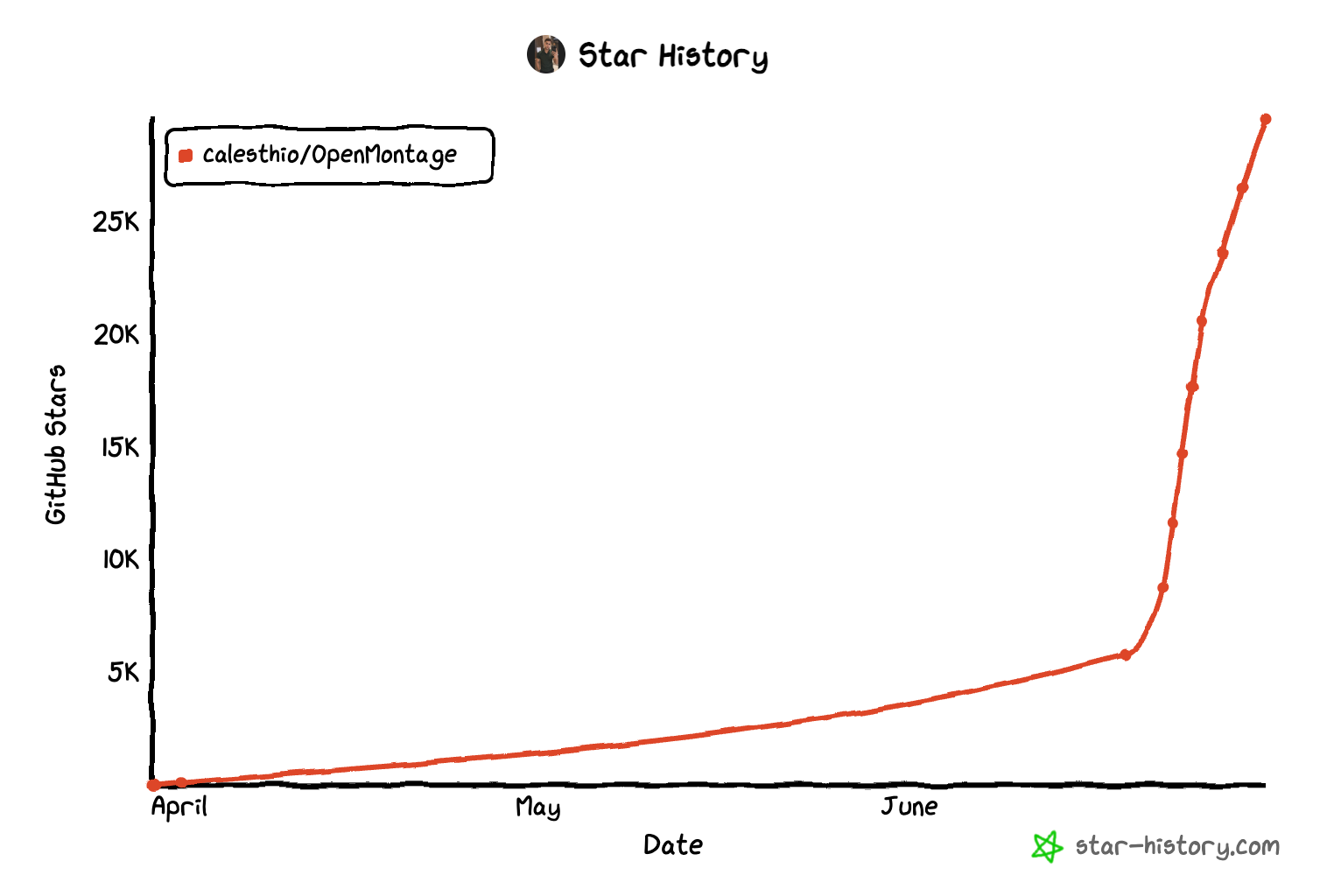
🎬 OpenMontage (GitHub) 30k ☆ - A coding agent reforged into a full video production studio

The Scoop: OpenMontage turns any AI coding assistant - Claude Code, Cursor, Codex, Copilot, Windsurf - into an end-to-end video studio. You describe what you want in plain language and the agent runs research, scripting, asset generation, editing, and final composition through a pipeline of skills. AGPL-3.0, by calesthio AI Labs, mostly Python.
Why It’s a Big Deal
It is the purest expression of this issue’s thesis: there is no bespoke “video agent” here, just a general coding agent plus a folder of skills. The capability lives in instructions, not in a binary.
It treats video production like engineering - twelve pipelines, scored provider selection, quality gates, and audit trails - so the agent works like a studio rather than a prompt-to-clip toy.
It makes real footage, not just animated stills - the documentary pipeline builds a CLIP-searchable corpus from open archives and cuts an actual timeline, which is the line most “free AI video” stacks quietly never cross.
Under the Hood
An agent-first architecture with no code orchestrator: the coding agent reads YAML pipeline manifests and Markdown stage-director skills, calls 52 Python tools, self-reviews, checkpoints state to JSON, and pauses for your approval at each creative decision.
A three-layer knowledge stack - tools and pipeline definitions for what exists, skills for how OpenMontage wants them used, and external knowledge packs for how each provider works - with 500+ agent skills in total.
Scored provider selection across seven dimensions over 14 video models, 10 image models, and 4 TTS engines (FLUX, Veo, Kling, WAN, Piper and more), plus pre-compose and post-render gates that run ffprobe, frame sampling, and audio analysis before you ever see a frame.
OpenMontage is what happens when the coding agent stops shipping code and starts shipping cuts - a full production studio that lives entirely in a folder of skills.
🔭 ON THE RADAR
Stuff that’s hot and is trending at over 10K stars.
👁️ supervision (GitHub) 45.5k ☆ - The reusable toolkit that gives an agent eyes

The Scoop: supervision is Roboflow’s model-agnostic computer vision toolkit - the reusable building blocks for detection, tracking, annotation, and dataset wrangling that sit between any vision model and a working application. MIT, Python.
Why It’s a Big Deal
An agent that has left the text box still needs hands for pixels, and supervision is the most-reached-for set of them - plug in any detector or segmenter and get back a clean, uniform set of detections.
It is quietly retrofitting for the agent era: the repo now ships AGENTS.md and CLAUDE.md, so a coding agent can learn how to use the library the same way a human would.
It turns one-off vision scripts into composable primitives - zones, trackers, annotators, dataset converters - which is exactly the shape an agent needs to assemble a pipeline without reinventing the plumbing.
Under the Hood
A model-agnostic detections API with connectors for Ultralytics, Transformers, MMDetection, Inference, and RF-DETR, plus highly customizable annotators for boxes, masks, and labels.
Trackers, line and zone counters, and dwell-time and speed-estimation utilities, alongside dataset tools to load, split, merge, and save COCO, YOLO, and Pascal VOC.
The 0.28 release adds CompactMask and SAM3 support, keeping the toolkit current with the latest segmentation models.
supervision is the toolkit a generalist agent reaches for the moment the task stops being text on a screen and starts being pixels in a frame.
🦉 strix (GitHub) 27.8k ☆ - A coding agent handed a hacker’s toolkit

The Scoop: Strix are autonomous AI agents that behave like real hackers - they run your code dynamically, find vulnerabilities, and prove them with working proof-of-concepts instead of flooding you with false positives. Apache-2.0, Python, sandboxed in Docker.
Why It’s a Big Deal
It is the same generalist agent pointed at a different trade: give it a security toolkit and it becomes a penetration tester that validates findings, not a scanner that guesses.
Real proof-of-concepts are the whole point - it reproduces a vulnerability before reporting it, which is the difference between a fixable ticket and static-analysis noise.
A “graph of agents” turns one tester into a team - specialized agents split across attack surfaces and run in parallel, the way a real red team would.
Under the Hood
A full toolkit out of the box: an HTTP proxy, multi-tab browser automation for XSS and auth flows, interactive shells, a Python runtime for custom exploits, recon and OSINT, and static plus dynamic code analysis.
Multi-agent orchestration that distributes specialized agents across assets and shares discoveries between them as they go.
CLI-first with a headless mode and GitHub Actions integration, so a pull request can be pentested and auto-fix PRs proposed; built on LiteLLM, Caido, Nuclei, Playwright, and Textual.
strix is what a coding agent becomes when you hand it a hacker’s toolkit instead of a feature request.
✂️ video-use (GitHub) 12.4k ☆ - Edit video with a coding agent, by reading it instead of watching it

The Scoop: video-use lets a coding agent edit raw footage into a finished cut. Drop your takes in a folder, chat with the agent, get final.mp4 back. The trick: the model never watches the video, it reads a structured view of it. MIT, from the Browser Use team, shipped as a skill.
Why It’s a Big Deal
It carries the browser-use insight into a new medium - give the LLM a structured representation, a transcript plus an on-demand composite rather than a 30,000-frame firehose, and editing becomes a reasoning task instead of a vision-bandwidth problem.
It ships as a skill you register with Claude Code, Codex, or any shell agent, so the editing craft travels with the agent rather than living locked inside a separate app.
It closes its own loop - the agent self-evaluates the rendered output at every cut boundary and re-renders until it passes, so you only see work that already checked itself.
Under the Hood
Layer one is an ElevenLabs Scribe transcript with word-level timestamps, speaker diarization, and audio events, packed into a roughly 12KB markdown file that serves as the agent’s primary reading surface.
Layer two is a timeline view, an on-demand filmstrip plus waveform plus word-label composite the agent renders only at ambiguous decision points.
A Transcribe to Pack to Reason to EDL to Render to Self-Eval pipeline on FFmpeg, with filler-word cuts, automatic color grading, 30ms audio fades, burned subtitles, and session memory persisted to project.md.
video-use proves the move that makes all of this work - give the agent a structured reading of the world, not the raw firehose, and let a skill do the rest.
🔬 BELOW THE RADAR
Our hot picks for recent OSS projects to keep a close eye on for the future.
☁️ agents-cli (GitHub) 3.9k ☆ - A skill suite that teaches a coding agent to build other agents

The Scoop: agents-cli is Google’s CLI and skill set that turns any coding assistant into an expert at scaffolding, evaluating, deploying, and governing agents on the Gemini Enterprise Agent Platform. It is explicitly a tool for coding agents rather than a coding agent itself - the clearest sign yet that “install a skill” is becoming how capability ships. Works with Claude Code, Codex, Antigravity CLI, and any other coding agent. Apache-2.0.
Get started: npx skills add google/agents-cli (or uvx google-agents-cli setup)
🎨 astryx (GitHub) 1.5k ☆ - Meta’s design system, rebuilt as one system for humans and agents

The Scoop: astryx is the design system that grew inside Meta over eight years - 13,000+ apps, 150+ components - now open-sourced as React plus StyleX with a deliberate twist: the API, docs, and CLI are designed so a person and an AI assistant build the exact same way, from the same reference. It ships a CLAUDE.md and treats “agent ready” as a first-class principle, not a bolt-on. MIT, in beta.
Get started: npm install @astryxdesign/core @astryxdesign/theme-neutral then npm install -D @astryxdesign/cli
🐑 herdr (GitHub) 8.8k ☆ - A terminal-native multiplexer for herding many agents at once

The Scoop: herdr is a single Rust binary that lives inside your terminal and gives you workspaces, tiled panes, automatic agent detection, and at-a-glance state for every coding agent you have running - blocked, working, done, or idle. Once you are running a fleet of specialized agents, you need somewhere to watch them, and herdr is that surface. Agents can drive it too, through a local socket API and its own SKILL.md. Fittingly, it was built almost entirely by the agents it manages. AGPL-3.0.
Get started: curl -fsSL https://herdr.dev/install.sh | sh
Repository Radar is brought to you by Alexander, a Tech Investor at Keen, and Claudius, the co-founder of Index Labs. In this Substack, we focus on software infrastructure and open-source innovation in AI and beyond, tracking major trends while uncovering the hidden gems shaping the future of technology.
The design of the images is gorgeous!